
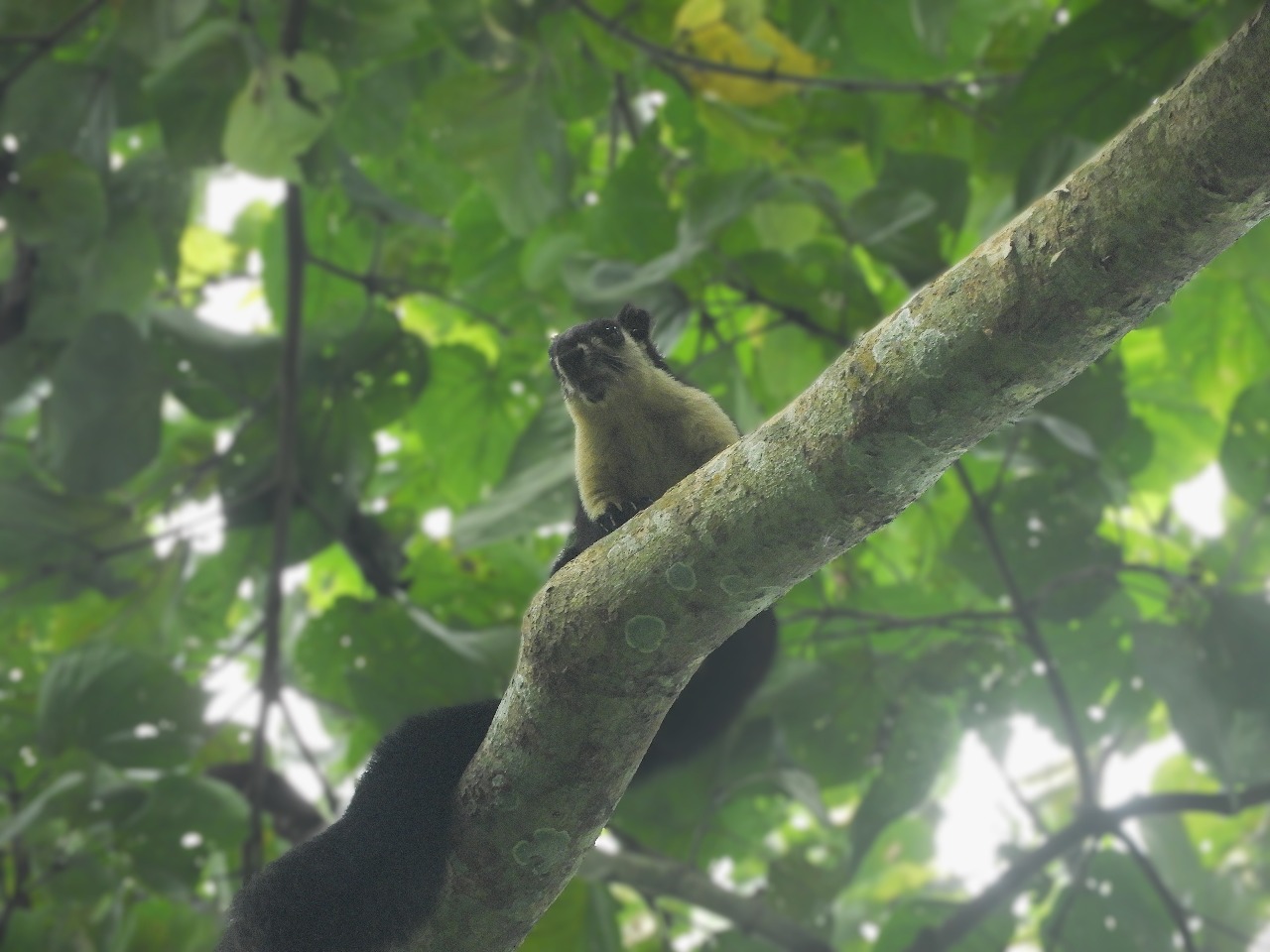
The black giant squirrel (Ratufa bicolor), the world’s largest squirrel found in Nepal’s forests, is a rare and captivating wildlife species. Recently, it has been spotted at two strikingly different altitudes in Sunsari District—189 meters in Char Kose Jhadi and 1,103 meters in Osho Park, Dharan. This unusual altitudinal range highlights the squirrel’s incredible adaptability, thriving in ecosystems ranging from subtropical Terai to temperate mid-hill forests.
A Rare and Unforgettable Encounter
In October 2014, during a birdwatching trip near Char Kose Jhadi Talatalaiya wetland, we were fortunate enough to spot this magnificent creature. It was my first sighting, and the experience was unforgettable. The sheer size of the squirrel was astonishing—far larger than I had imagined. When we attempted to observe it closely, the squirrel, sensing our presence, leaped to another tree. Respecting its comfort, we let it be and continued our birdwatching, grateful for the brief but magical encounter.
Two months later, in December, another birdwatching expedition in Osho Park, Dharan, brought another surprise. Amidst sightings of various birds and butterflies, we suddenly came across the giant squirrel again in the dense forest. This time, we captured its photo, adding to our excitement.
A Species of Wonder and Ecological Importance
The black giant squirrel is one of South and Southeast Asian's largest squirrels. Its dark brown-to-black upper body, light yellow abdomen, and long, bushy tail make it unmistakable. Active during the day, it feeds on fruits, seeds, leaves, flowers, and occasionally insects.
Globally, the IUCN lists it as Near Threatened, while in Nepal, it is classified as Endangered. Its preferred habitats—moist broadleaf, semi-evergreen, and evergreen forests—are under threat. Char Kose Jhadi’s subtropical vegetation (dominated by Sal, Khair, and Seuti trees) and Osho Park’s cooler climate (with Chilaune, Katus, and Uttis trees) showcase its adaptability.
Conservation Challenges and the Way Forward
As a key seed disperser, this squirrel plays a vital role in forest regeneration. However, deforestation, habitat fragmentation, climate change, and urbanization threaten its survival. Protecting biological corridors in Sunsari, engaging local communities in conservation, and conducting further research on its habitat preferences are crucial steps.
The squirrel’s presence at varying altitudes demonstrates its resilience, but without immediate action, its future remains uncertain. Scientific studies, community involvement, and long-term conservation strategies are essential to ensure that future generations can witness this majestic creature, not just in photos, but in the wild, where it truly belongs.
The time to act is now—for the squirrel, for the forests, and for the balance of nature itself.

Lelin Giri( BSc 3rd year Zoology student)Central Campus Of Technology, Dharan